
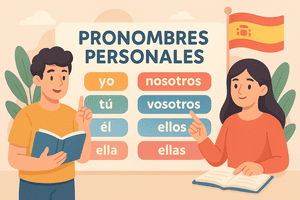
Personal pronouns
Choose the correct Spanish personal pronoun for the speaker, the person addressed, and those being talked about, and understand when it can be omitted.
Spanish Minute
Progress in this browser
Choose the correct Spanish personal pronoun for the speaker, the person addressed, and those being talked about, and understand when it can be omitted.
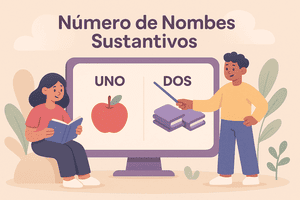
Learn to form and recognize the plural form of Spanish nouns according to the main rules.
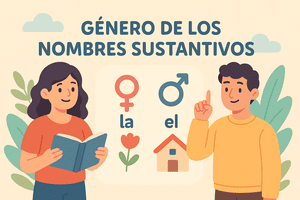
Understand and identify the gender of Spanish nouns, use definite articles correctly, and recognize common exceptions.
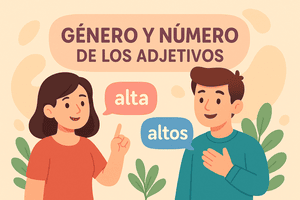
Learn to match adjectives with nouns in gender and number, recognize main endings, and correctly build simple phrases.
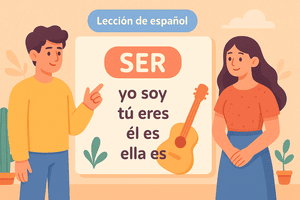
Learn to use the verb ser for identification, description, profession, origin, and time. Understand when to omit the article with professions and distinguish ser from estar for qualities and states.
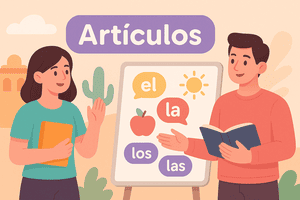
Learn to use definite and indefinite articles in Spanish, distinguish them by gender and number, and correctly use al and del.
Learn to use the verb estar to indicate the location and state of objects and people.
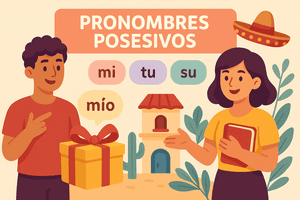
Learn to say whose something is in Spanish. You’ll use one form before a noun and another on its own, for example after ser.
Learn to use the verb hacer in the present tense to express actions, making, weather, and indicating past time.
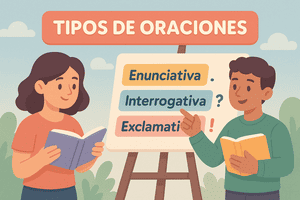
Learn to tell whether a sentence makes a statement, asks a question, expresses a feeling, or prompts someone to act. Then practise changing one sentence type into another.
Learn to build Spanish sentences and identify subjects, predicates, objects, and details of time, place, and manner. When reordering a sentence, keep who acts, when, and who or what the action involves.
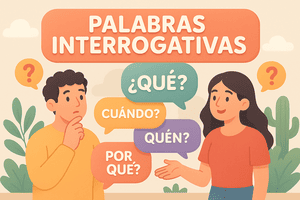
Learn how to ask about a thing, a person, a place, a time, a way of doing something, a quantity, or a reason. Practise choosing the question word, accent mark, and preposition.
Learn to use the verb tener to express possession, age, certain set expressions, and the construction tener que + infinitive.
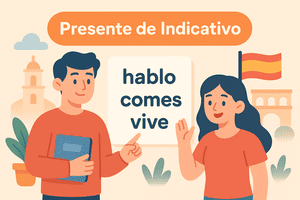
Learn to recognize and use the present tense (presente de indicativo) to describe current, habitual, and planned actions.
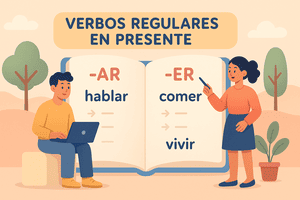
Learn to conjugate and use regular -ar, -er, -ir verbs in the present tense.
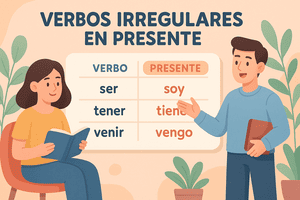
Learn to recognize and correctly conjugate irregular verbs with stem changes and special yo forms in the present tense.
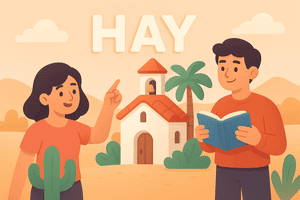
Learn to use the construction hay to express the existence of something in the present tense, distinguish between indefiniteness and definiteness, and differentiate hay from estar.
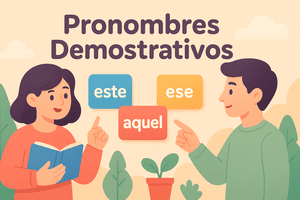
Learn to distinguish and correctly use the demonstrative pronouns este, ese, aquel and their forms by gender and number, as well as the neutral forms esto, eso, aquello.
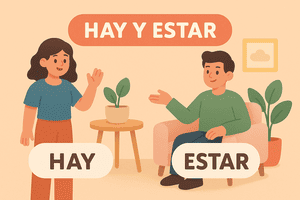
Learn to distinguish and correctly use hay and estar to describe existence and location of objects.
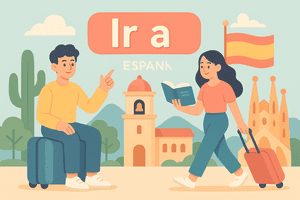
Learn to use ir a to express direction and near-future plans.
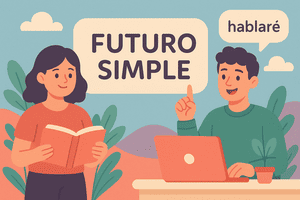
Learn to form and use the simple future tense Futuro Simple to express future actions and plans, and distinguish it from the ir a + infinitive construction.
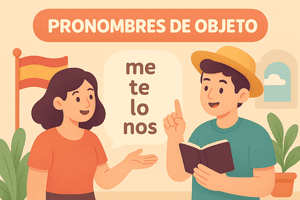
Learn to distinguish and correctly use direct and indirect object pronouns in simple Spanish sentences.
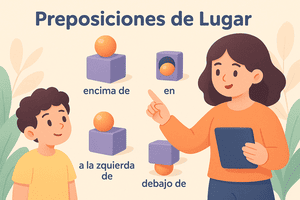
Learn to use basic Spanish prepositions to describe the location of objects and people.
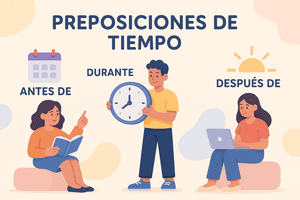
Learn to connect an action with time and to distinguish an exact hour, a broader period, its boundaries, and duration.
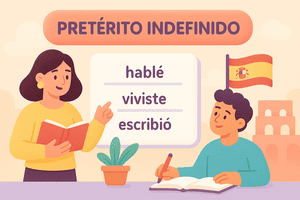
Learn to recognize and correctly use the Pretérito Indefinido to express completed actions in the past, and master its main endings and forms.
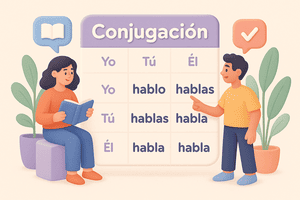
Understand what conjugation is, learn to identify the stem and endings, distinguish verb classes, and choose the correct form by person and tense.
Learn to use poder to say what someone can do, ask for permission, and describe what might happen.
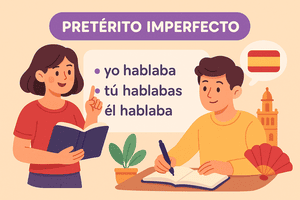
Learn to describe what life used to be like and what was happening in the background. Then practise the Imperfecto endings and the forms of ser, ir, and ver.
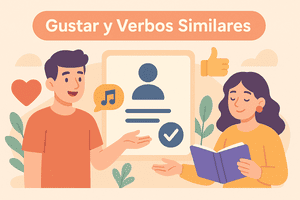
Learn to say what people like or find interesting. Choose a pronoun for the person and match the verb to the thing or activity.
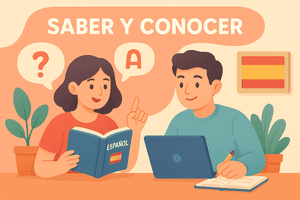
Learn how to use saber to talk about facts and skills, and conocer to say who or what you are familiar with.
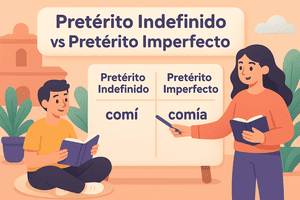
Learn to distinguish and correctly use the past tenses Pretérito Indefinido and Pretérito Imperfecto to describe events and background in the past.