
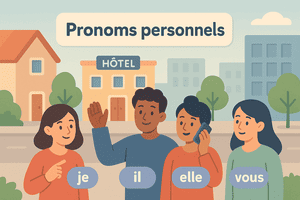
Personal subject pronouns
Use the situation to identify who is speaking, who is being addressed, or who is being talked about. Build a short statement with the right French pronoun.
French Minute
Progress in this browser
Use the situation to identify who is speaking, who is being addressed, or who is being talked about. Build a short statement with the right French pronoun.

Choose the present-tense form of être to say who someone is, where they are, or how they are.

Use avoir in the present tense to tell what people have and how old they are.

Form a simple present tense statement with a regular -er verb.
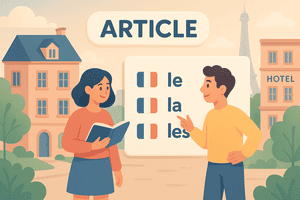
Choose the indefinite, definite, or partitive article in short phrases based on meaning and the form of the noun.
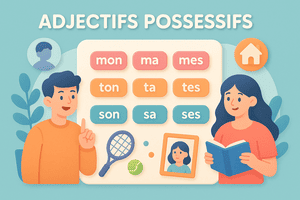
Choose the French form for ‘my’, ‘your’, ‘his’, ‘her’, ‘our’ or ‘their’ based on the owner and the gender and number of the noun.

Replace a noun with celui, celle, ceux or celles and show which person or thing you mean.
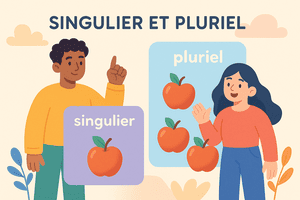
Indicate more than one object and choose the plural spelling of common French nouns.

Choose the simple form of the adjective according to the gender and number of the noun and know where to place it in the given phrases.
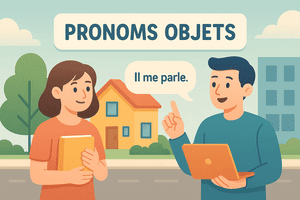
Replace an already mentioned object with the forms le, la, l’, les, lui, or leur in simple affirmative sentences.
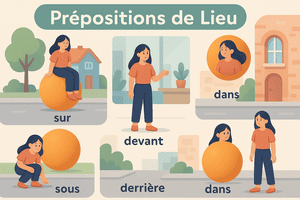
Express the position of an object relative to another thing or place.
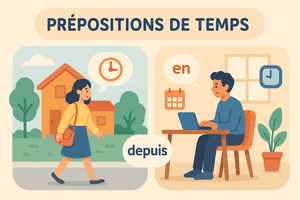
Indicate when an event will happen, how long an action lasts, and how long it takes to get a result.
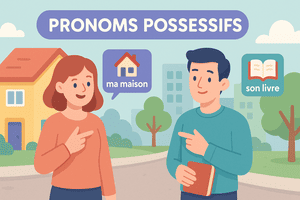
Replace a phrase with the name of an object with a possessive pronoun, keeping the owner, gender, and number.
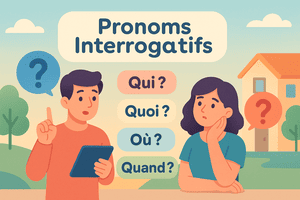
Ask who is doing the action, who or what it concerns, and choose among known options.
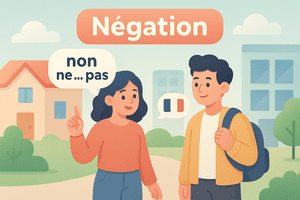
Build a full written negation in simple sentences with ne … pas and ne … jamais.
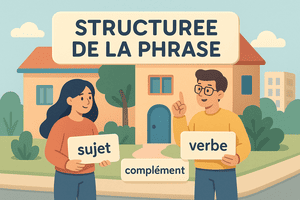
Build a French statement with an action or description and add place and time.
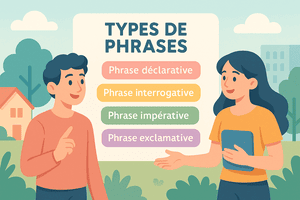
Distinguish a statement, direct question, request, and exclamation, then build each using a simple model.

Use the present tense for actions happening now, habits, states, general facts, and schedules.
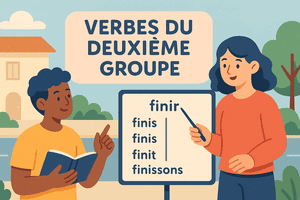
Recognize the regular finir model and use its present tense forms.
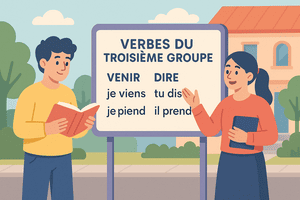
Recognize several third group patterns and use partir, prendre, faire, and aller in the present tense.

Emphasize an action happening right now using être en train de and the infinitive.

Express intention or an expected event using aller and the infinitive, including negation.

Describe presence and absence, ask about presence, and understand the time meaning “ago”.
Compare qualities and actions, show that two things are equal, and pick out the highest or lowest in a group.